Team reflection after team building that sticks
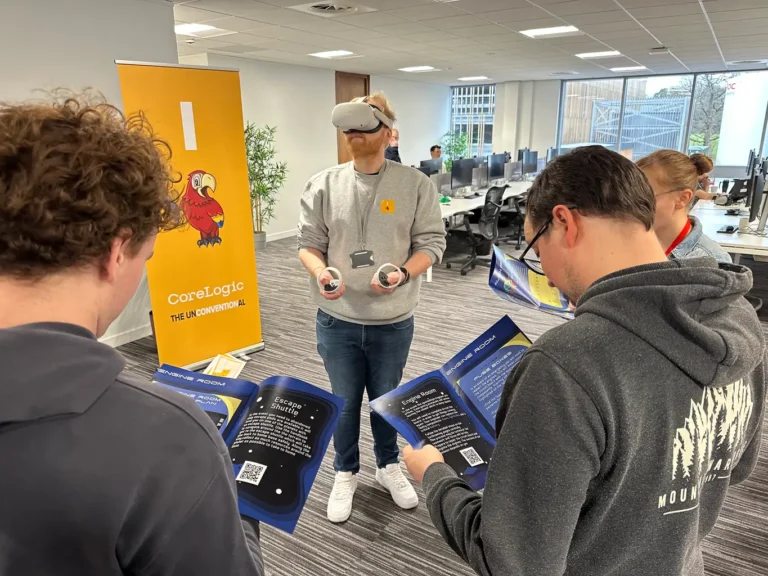
The escape room ends, the headsets come off and the room is still buzzing. That is the moment many organisations lose the most valuable part of the experience. Team reflection after team building turns a high-energy shared challenge into evidence: how people communicate, who takes control, what happens under pressure and where good intent gets lost.
A social activity can lift morale for an afternoon. A structured reflection can improve how a team plans, challenges, decides and delivers long after the event. The difference is not a clever set of questions. It is a facilitated conversation that connects what people did in the room with the behaviours they need at work.
Why the debrief matters more than the activity
When teams are absorbed in a competitive problem-solving challenge, their usual patterns become easier to see. Someone may move quickly towards action while another needs time to test the assumptions. A confident voice may set the pace. A quieter colleague may spot a risk that the group has missed. Under time pressure, people often default to their behavioural preferences rather than the role they think they should play.
That makes the experience useful, but only if the team stops to examine it. Without reflection, participants may remember the funniest mistake or who found the final clue. They are less likely to notice that unclear roles caused duplication, that questions were treated as resistance, or that the team recovered only once it began sharing information properly.
The aim is not to judge personalities or label people as difficult. It is to build behavioural awareness. Teams perform better when members can recognise different working styles and flex their approach accordingly. Direct communicators may need to create more space for input. Detail-focused colleagues may need to signal the key point earlier when urgency is high. Neither approach is inherently better. Performance depends on using the right behaviour at the right moment.
Set up reflection before the event begins
A useful debrief starts with clear expectations. Tell participants that the challenge is not a test of intelligence, seniority or technical expertise. It is an opportunity to observe how the team works together when information is incomplete and the clock is running.
This framing protects psychological safety. People are more likely to speak honestly when they know the conversation will focus on behaviours and choices, not blame. It also helps leaders resist the temptation to turn the debrief into a performance appraisal.
A facilitator should observe the team against a small number of relevant themes. For most teams, these are communication, decision-making, role clarity, conflict response and adaptation. The themes should reflect a genuine business need. A newly formed project team may need to establish ways of working. A leadership group facing rapid change may need to examine how it makes decisions. A cross-functional department may need to surface the friction created by competing priorities.
Avoid trying to diagnose every possible issue in one session. Reflection is sharper when it has a clear purpose.
Use questions that move beyond “Did you enjoy it?”
Enjoyment matters. It creates engagement, shared energy and a positive memory. But it is not proof of development. The strongest questions invite participants to describe what happened before deciding what it means.
Start with facts. What did the team do first? When did progress stall? What information was available but not shared? Which decisions were made quickly, and which were delayed? These questions reduce defensiveness because they anchor the conversation in observable moments.
Then move to interpretation. Ask how the group decided whose idea to follow, whether everyone had a route into the conversation, and what happened when two people disagreed. Explore what changed when the pressure increased. A team may discover that it communicates well when calm but becomes fragmented when deadlines tighten. That is a valuable finding because it points directly to a workplace risk.
Finally, bring the discussion back to work. Where does this pattern show up in meetings, customer projects or operational handovers? What is the cost when it happens? The link must be specific. “We need better communication” is too broad to change anything. “We will confirm the decision owner and next action before every project meeting ends” is clear enough to practise.
Make behavioural preferences useful, not restrictive
Behavioural preference modelling gives teams a practical language for discussing difference. It can explain why one person wants a fast verbal decision while another prefers to review the evidence first. It can show why a colleague’s focus on relationships, process or outcomes may be an asset rather than an obstacle.
The value lies in application. Teams should not leave saying, “That is just how I am.” They should leave asking, “What does this person need from me to contribute at their best?” This is behavioural flexibility in action.
For example, a decisive project lead may agree to ask for challenge before closing a decision. A more reflective team member may commit to sharing an early view rather than waiting for a perfect answer. A relationship-focused colleague may recognise when the team needs a clear call rather than a longer conversation. These adjustments are small, but they change the quality and pace of collaboration.
There is a trade-off. Too much adaptation can make a team hesitant or artificial, particularly in a fast-moving environment. The goal is not for everyone to communicate in the same way. It is to make differences visible, purposeful and easier to work with.
Turn insight into two or three team commitments
The most common failure in team reflection after team building is ending with a long list of worthy intentions. Teams do not need ten new habits. They need a few commitments they can recognise, practise and revisit.
Choose actions that meet three tests: they address a pattern witnessed during the experience, they are within the team’s control, and they can be observed in normal work. Good commitments are concrete enough for colleagues to hold one another to account without becoming punitive.
A team working through decision bottlenecks might agree to name a decision owner at the start of each discussion and specify the level of input required. A cross-functional group that discovered it made assumptions might introduce a two-minute check: what do we know, what do we need, and who owns the next step? A leadership team that noticed quieter voices disappearing under pressure might build a deliberate round of input into key meetings.
Write the commitments down in the language the team uses. Assign an owner to prompt the first review, but do not make that person solely responsible for change. Team habits are collective work.
Follow up while the experience is still fresh
The first check-in should happen within a week or two, before the event becomes a distant memory. Keep it short and practical. Ask where the new behaviour has been used, what got in the way and what needs adjusting. The point is not to prove that change has already been perfected. It is to keep attention on the work.
A second review after four to six weeks is often where the real learning appears. The team can compare intention with reality. Perhaps the agreed meeting structure has helped, but difficult decisions still get moved offline. Perhaps role clarity has improved on projects, but not during urgent operational issues. This is not failure. It is useful data for the next adjustment.
Leaders have a particular role here. If they ask about the commitments, model the agreed behaviours and make time for honest challenge, the reflection gains credibility. If they treat it as an HR initiative that sits outside the day job, the team will do the same.
When an external facilitator adds value
Teams can reflect on their own, especially when trust is high and the challenge is straightforward. Yet an experienced facilitator can notice patterns participants miss, keep dominant voices from taking over and ask the question that moves the conversation from polite agreement to productive honesty.
This is especially valuable where conflict, hierarchy or cross-functional tension is already present. People may be reluctant to name a pattern directly in front of a senior colleague. A facilitator can keep the focus on what was observed, create space for contrasting perspectives and turn the discussion towards practical action.
At Teams Glued, immersive VR challenges create a live, shared reference point for this work. The technology gets people involved quickly; the facilitated reflection is where teams connect, adapt and lead more effectively.
The best closing question is often the simplest: what will we do differently when the next real pressure point arrives? Keep that question visible, then give the team a chance to answer it in the work that follows.