Collaborative Problem Solving Training That Sticks
A project stalls. Two departments have different priorities. The meeting gets longer, but no clearer. This is where collaborative problem solving training earns its place – not as a pleasant away day, but as a practical way to change how people think, communicate and act when the pressure rises.
Most workplace problems are not caused by a lack of intelligence or effort. They are caused by missed assumptions, unclear ownership, competing communication styles and decisions made before the right voices have been heard. Teams need more than a framework they can repeat in a meeting. They need a shared experience that makes their habitual behaviours visible, then gives them a better way to respond.
What collaborative problem solving training should change
Effective training does not simply teach people to be more agreeable. Productive collaboration includes challenge, disagreement and competing perspectives. The goal is to help people use those differences well.
A strong programme improves the moments that usually derail delivery: when a colleague needs more detail while another wants to move quickly; when a leader takes control too soon; when someone spots a risk but does not feel able to raise it; or when a team mistakes polite silence for alignment.
The result should be behavioural, not theoretical. Participants leave knowing how their own preferences affect the group, how others may interpret their approach and what they can do differently in the next project meeting, handover or difficult conversation.
This matters most for cross-functional teams. Finance, operations, sales, technology and people functions often view the same issue through different measures of success. None is necessarily wrong. But without a way to surface and work through those perspectives, decisions become slow, defensive or poorly owned.
Why real pressure reveals more than discussion
A classroom conversation about collaboration can be useful, but it has limits. People generally describe their best intentions when asked how they behave at work. A live challenge shows what happens before they have time to manage the impression.
Put a group under a time limit with incomplete information and a shared goal, and patterns emerge quickly. Who starts directing? Who gathers evidence? Who keeps the team connected? Who withdraws when their idea is dismissed? Who focuses so heavily on the task that they stop checking whether everyone understands the plan?
These are not personality flaws. They are working preferences, and every preference can add value. The issue arises when a team relies too heavily on one style or treats a contrasting style as difficult rather than useful.
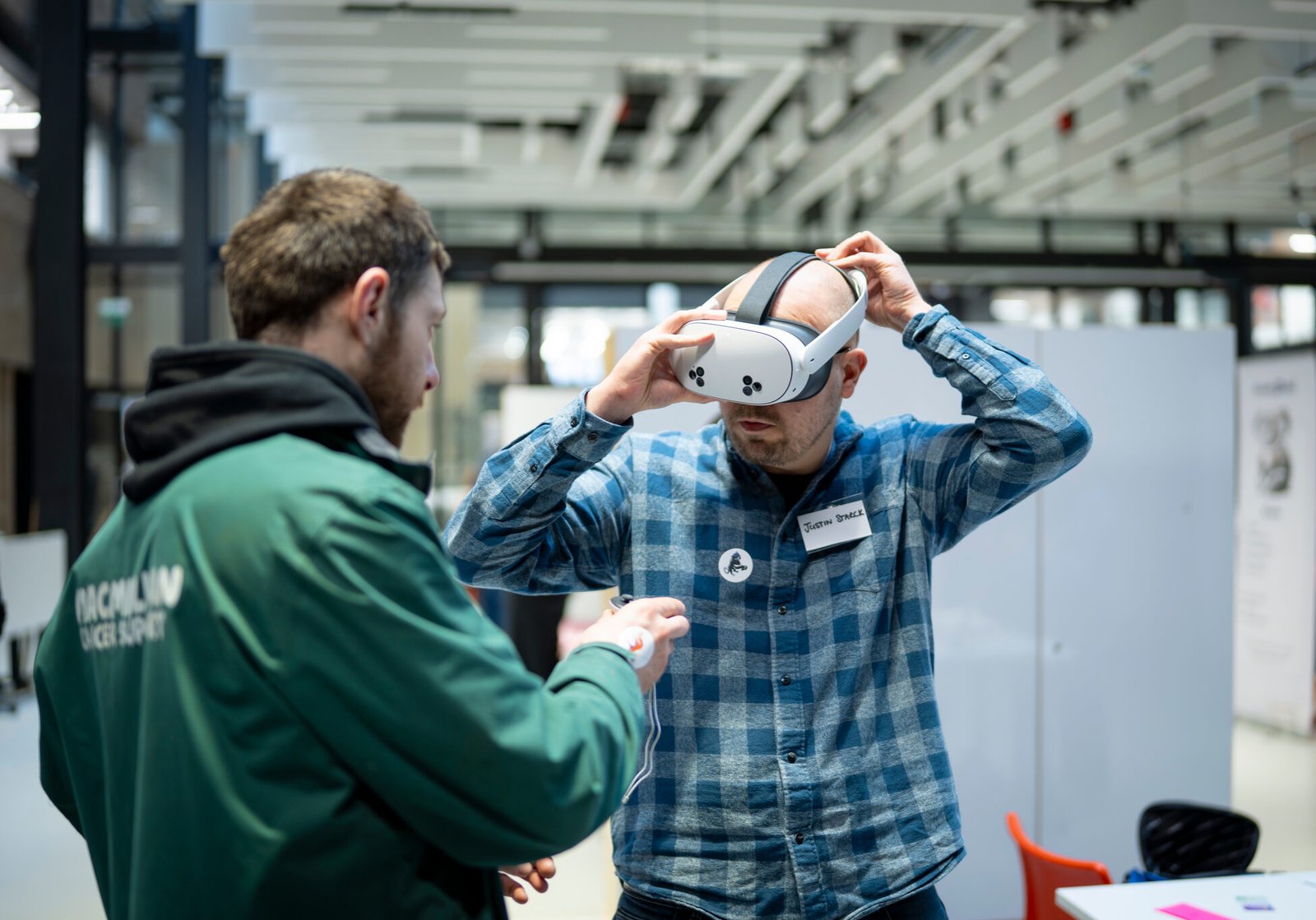
Immersive problem-solving challenges make these dynamics visible without placing a real client account, deadline or business relationship at risk. In a virtual reality escape-room scenario, for example, participants must communicate clearly, prioritise, test ideas and adapt to changing information. The activity creates genuine energy and urgency, while a skilled facilitator turns what happened into meaningful workplace learning.
That distinction is critical. Entertainment alone may create a memorable afternoon. Facilitated reflection connects the experience to performance.
The behaviours behind better decisions
Collaborative problem solving is sometimes presented as a soft skill. In reality, it affects delivery speed, quality, risk management and employee experience. Teams make better decisions when they can combine different forms of expertise without getting trapped in status, habit or noise.
Training should focus on a small number of observable behaviours. First, teams need to establish the problem before rushing towards a solution. A group can spend an hour debating answers to the wrong question because nobody has clarified the outcome, constraints or decision owner.
They also need to share information deliberately. In many teams, key knowledge stays with the people who assume it is obvious, or who are not invited into the conversation early enough. Clear prompts such as “What are we missing?” and “Who sees this differently?” can change the quality of a discussion.
Next comes behavioural flexibility. A decisive colleague may need to pause and invite input. A reflective colleague may need to contribute before they have every detail. Someone who naturally builds harmony may need to name tension rather than smoothing it over. Flexing behavioural styles is not about becoming someone else. It is about choosing the response the situation needs.
Finally, teams need a reliable way to close. Good collaboration is not endless consensus. It means reaching clarity on the decision, the rationale, the actions, the owner and the point at which progress will be reviewed.
Collaborative problem solving training works when reflection is specific
The quality of the debrief determines whether an experience becomes development or remains a story people tell at lunch. “We should communicate better” is too vague to change anything. Participants need to identify precisely what they did, what effect it had and what they will test next.
A useful facilitated discussion might explore where the team lost time, whose input changed the direction of the task and which assumptions went unchallenged. It can examine how people responded when the first plan failed. Did they blame, rush, retreat, ask better questions or regroup?
Behavioural preference modelling adds another layer. When individuals understand the conditions in which they are likely to be direct, cautious, detail-focused, spontaneous or relationship-led, the team gains a practical language for adapting. Instead of saying, “You are impossible to work with,” they can say, “We are moving at different speeds – what information do you need to commit?”
That shift reduces friction without pretending that all conflict is bad. Some conflict is necessary. The aim is to make it constructive, focused on the work and safe enough for people to challenge ideas early.
What to look for in a programme
Not every collaborative problem solving intervention will suit every organisation. A leadership team dealing with strategic tension needs a different level of challenge from a newly formed project group. A team recovering from conflict may need more psychological safety and structured dialogue before introducing competition. It depends on the team’s context, trust levels and business pressure.
When assessing options, look beyond the activity itself. Ask whether the experience creates visible participation from everyone, not only the most confident voices. Check whether the facilitator can connect observed behaviour to real workplace situations. Ensure there is time for individual reflection, team commitments and follow-through.
The strongest programmes balance challenge with support. They give people enough pressure to reveal default habits, but not so much that the exercise feels like a test they can fail. They avoid labelling people and instead build awareness, curiosity and practical choice.
Teams Glued uses immersive VR challenges alongside behavioural insight to create that balance. Participants have a shared event to refer back to, making later conversations about communication, decision-making and conflict more concrete. For organisational buyers, that makes the learning easier to carry into team meetings, project kick-offs and performance conversations.
Turning insight into workplace habits
A single session can create momentum, but it will not fix a team’s operating rhythm on its own. The best follow-through is simple and visible. Teams should agree a small number of behaviours to practise in live work, rather than producing a long list of intentions that disappears into a shared folder.
For example, a project team may decide to clarify the decision owner at the start of each key discussion, invite a challenge before committing and end with named actions. A leadership group may agree to separate exploration from decision-making, so people know whether a meeting is for generating options or choosing a direction.
Managers have a particular role here. If leaders ask for honest challenge in training but shut it down in the next operational meeting, the message is immediate. If they model curiosity, explain their decisions and make space for different working styles, they reinforce the behaviour the team is trying to build.
It is also worth measuring what changes. Look for faster escalation of risks, clearer handovers, fewer repeated conversations, improved decision ownership and more balanced participation. Employee feedback matters, but so do practical signs that work is moving with less friction.
The real test comes after the session, when a deadline shifts, a stakeholder pushes back or the team’s first idea does not work. That is the moment to pause, use the shared language and choose a better response together. Connect. Adapt. Lead.