10 Best Team Communication Exercises at Work
A project can look healthy on a status report and still be one unclear handover away from delay. The best team communication exercises do more than get people talking: they reveal how colleagues listen, explain, challenge, decide and respond when time or information is limited. That is where communication becomes a performance issue, not a soft skill.
For HR and L&D leaders, the aim is not to fill a workshop with pleasant conversation. It is to create a shared experience that makes unhelpful habits visible, gives people language for different working styles and leaves the team with practical agreements they can use on Monday morning.
What makes a communication exercise worth the time?
A strong exercise creates a realistic communication demand. People need to interpret incomplete information, coordinate competing priorities, make choices and recover when something goes wrong. If the task is too easy, participants can stay polite and performative. If it is too complicated, the learning gets lost in confusion.
The debrief matters as much as the activity. Ask what participants noticed about their own behaviour, whose contribution was missed, when assumptions appeared and how decisions were made. Then connect those observations to a live workplace challenge: a cross-functional launch, a stretched project team or a leadership group managing change.
Use the following exercises selectively. A newly formed team may need clarity and connection; an experienced team under pressure may benefit more from observing decision-making and conflict patterns.
10 best team communication exercises for work
1. Back-to-back drawing
Pair participants and seat each pair back-to-back. One person receives a simple image or diagram; the other has paper and pen. The person with the image must describe it without naming the object, while their partner draws it. Run one round without questions, then a second round where the drawer can ask clarifying questions.
The contrast is immediate. Teams see the cost of one-way instruction and the value of checking understanding. In the debrief, explore whether people gave context before detail, used clear landmarks or assumed that familiar words meant the same thing to everyone.
2. The information gap challenge
Give small groups a problem to solve, but distribute the essential information across individual cards. No one person has enough detail to reach the answer. It might be a scheduling puzzle, a customer scenario or a fictional operational incident.
This exercise surfaces who shares information early, who waits to be asked and who attempts to control the conversation. It is particularly useful for cross-functional teams where expertise sits in different departments. The lesson is not that everyone must speak equally at every moment. It is that the right information must reach the right people before the team commits to a decision.
3. Lost in translation
Ask one participant to read a short written brief privately. They then explain it verbally to a second person, who passes the message to a third, and so on. The final person shares what they heard, then compare it with the original brief.
The point is not to laugh at mistakes. It is to examine where meaning changed. Was the brief overloaded? Did people compress information because they were rushed? Did they fail to distinguish facts from interpretation? Use this to discuss how key messages travel through managers, project groups and shift handovers.
4. Silent prioritisation
Present a list of ten work-related items, such as actions to take during a service disruption or factors to consider before a major client meeting. Groups must rank them without speaking. They can use notes, gestures and movement, but no verbal discussion.
Silence quickly exposes non-verbal influence, patience and assumptions. Some people take charge through action; others withdraw when their first suggestion is moved. Afterwards, allow the group to complete the same task verbally. Discuss what communication channels helped and what was missing. This is a useful reminder that meetings are not the only place where team dynamics play out.
5. The five-minute briefing
Give each group a complex scenario and ten minutes to prepare a five-minute briefing for a senior stakeholder. The briefing must cover the situation, the recommendation, the risks and the next action. Add a constraint, such as conflicting data or a late change to the brief.
This tests whether a team can turn discussion into a clear message. Watch for teams that spend all their time analysing but never agree who will communicate the final position. In the debrief, focus on audience: did the group communicate what the stakeholder needed to know, or everything they knew?
6. Role-reversal problem solving
Bring a genuine friction point into the room, suitably anonymised where needed. Divide participants by role or function, then ask each person to argue the perspective of another department rather than their own. A sales colleague may represent operations; an operations colleague may represent the customer support team.
Role reversal builds empathy without requiring people to agree on every issue. It works best when the facilitator keeps the conversation specific. Ask what pressures, measures and risks shape each function’s choices. Teams often find that apparent resistance is a reasonable response to information they had not previously considered.
7. The assumption audit
Give teams a realistic statement, such as: “The client is unhappy because delivery was late.” Ask them to list what they know, what they believe and what they need to verify before acting. Then introduce new facts that challenge the first interpretation.
This is a sharp exercise for leadership and project teams that move quickly. It highlights the difference between speed and haste. The practical outcome should be a simple habit: before escalating, deciding or assigning blame, state the evidence, the assumption and the missing information.
8. The build under pressure
Give teams identical materials and a physical construction challenge with a tight deadline. The task could be building the tallest stable structure, creating a bridge that carries weight or assembling a model from instructions split across the group.
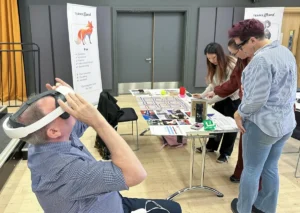
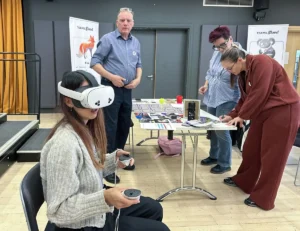
The activity itself is less important than the conditions. Add changing requirements, limited resources or a rule that one person cannot touch the materials. Under pressure, behavioural preferences become visible: some people direct, some analyse, some maintain harmony and some act before the plan is clear. A facilitated immersive challenge, such as the VR experiences used by Teams Glued, can make these patterns especially vivid because everyone must respond in real time.
9. Listening pairs
In pairs, one person speaks for two minutes about a work challenge while the other listens without interrupting. The listener then reflects back the issue, the emotions they heard and the outcome their colleague wants. Only then can they ask questions or offer ideas. Swap roles.
This sounds simple, which is why it is valuable. Many workplace conversations jump to solutions before the problem is properly understood. Ask participants how it felt to be listened to without being fixed. For managers, this can strengthen one-to-ones, performance conversations and early conflict resolution.
10. The decision log sprint
Give a team a scenario requiring several decisions in sequence. They must record each decision, the rationale, the owner, the deadline and what would cause them to revisit it. Halfway through, introduce fresh information that forces them to adapt.
This exercise links communication directly to execution. Teams often discover they have discussed a decision without actually making one, or agreed an action without agreeing who owns it. The decision log creates discipline while showing that changing course is not failure when new evidence justifies it.
Turn activity into behavioural change
Without reflection, even a high-energy exercise becomes a memorable hour rather than a development intervention. Give teams space to identify the behaviours that helped performance and the habits that created drag. Encourage specific language: “We interrupted before the full picture was shared” is more useful than “We need to communicate better.”
Then agree two or three working commitments. They might include clarifying the decision-maker at the start of a meeting, checking understanding before action, or inviting challenge from the quietest voice before closing a discussion. Keep the commitments observable so managers and colleagues can reinforce them.
It also helps to revisit the commitments after two to four weeks. Ask where the team used them, where pressure pushed them back into old patterns and what support they need next. Communication improves through repetition, feedback and behavioural flexibility, not a single good session.
Choose an exercise that reflects the pressure your team actually faces. When people can see their communication habits in action, they have a far better chance of changing them together.


Book a demo
Could your team benefit from Teams Glued?